
 Login
Login


10. August 2018
Sustainability in Numbers 2017
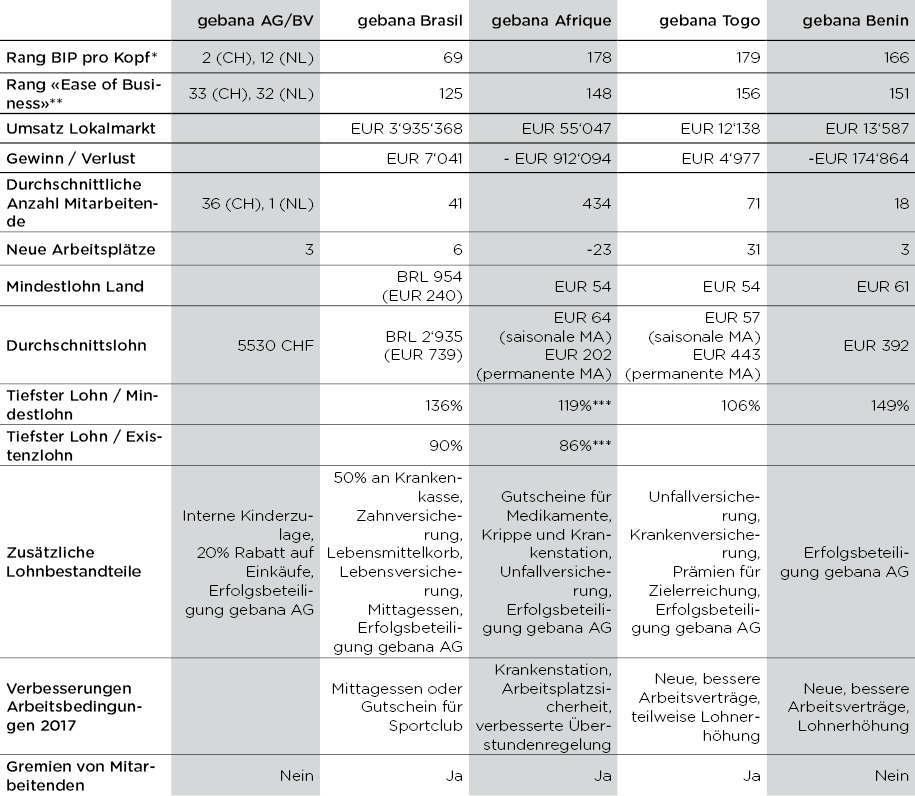
*Gross domestic product: Rank in the International Monetary Fund list 2017
**Difficulty of doing business: Rank in the World Bank "Ease of doing business" index 2017
***Still unclear for female workers who are paid per kg
In the past financial year, one of gebana’s sustainability focuses was the issue of minimum wage: All employees at gebana have a formal job and receive the statutory social benefits. gebana’s lowest wages are 6% to 49% above the national minimum wage. However, there is one caveat: the workers in cashew processing are paid per kg and are free to decide how many hours they want to work. In an analysis of whether monthly wages are also met in this area, we found that there are enormous differences between employees. Since the start of the new harvest we have therefore been pursuing two questions: What is the reason for the large differences, and are minimum wages also achieved on an hourly basis?
The minimum wage is only the first step on the way to a wage that allows a dignified life. That is why we also measure wages against the so‑called living wage, which is determined by independent organisations. While our average wages are clearly above living wages everywhere, this is not yet the case for the lowest wages. In Brazil we only reach 90%, in Burkina Faso 86% of the living wage. Why is it actually so difficult to pay at least the already very low living wages? Why are they not paid by any processor known to us and even less by cooperatives and farmers’ associations, not by Max Havelaar‑certified structures or other labels, and not by gebana?
Especially in rural areas, minimum wages are often not even reached. Yet the price difference that would make a living wage payable would be at most 1 franc per kg of final product! The reason lies in need: an enormous number of people apply even for very poorly paid work. For small firms that dry mangos, for example, the problem is that despite the lowest wages, sometimes acquaintances of the managers are hired instead of more competent workers.
Where manual labour in Africa competes with more efficient workers or machines in Asia, it is risky for farmers’ cooperatives or companies to improve working conditions. The dilemma is clearly visible in the case of cashews: the efficiency difference between Asia and Africa today amounts to around 2 francs per kg of processed cashews. For this reason it is worthwhile to export West African nuts to Vietnam for shelling – with devastating effects, read here.
For this reason the issue of minimum wages will continue to occupy us. The goal is to gradually raise all wages at least to the subsistence minimum.
Other important steps in the area of sustainability from the past fiscal year:
- Formalizing our vision and principles, which place social and ecological fundamentals at their core.
- Establishing a customer advisory board: This has the important task of providing an external perspective on our work and supporting us in evaluation issues and priorities.
- Supporting the Responsible Business Initiative (which demands that Swiss companies respect human rights abroad and can be held accountable for this): Its adoption and enforcement would contribute more to achieving our vision of changing trade in favor of farmers, local communities and the environment than our turnover. Therefore we, as a company, support the initiative and contribute our experience in the Global South to the discussions.
- Collaborating with Niels Jungbluth, a recognized expert with extensive experience in life cycle analysis. With him we examine our entire supply chains and assess them both by their environmental impact and by our influence on the individual areas and processes. The goal is to significantly strengthen our impact on the ground and make it easier to understand.