
 Login
Login

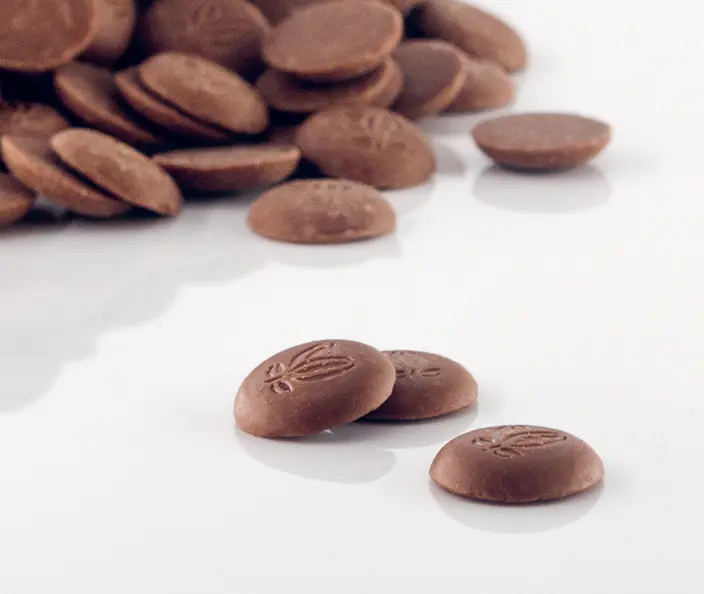
Milk chocolate
Organic
Togo
The Felchlin chocolatiers in central Switzerland use cocoa from gebana Togo to produce first-class, confectionery-quality milk chocolate. It has a cocoa content of 38%. Thanks to the coin shape, the chocolate is easy to portion, whether as a snack or for a recipe.
Best before 27.11.2026
Best before 27.11.2026
 How much is that?

Storage & shelf life
Store the chocolate in a cool, dry place away from light – ideally in the cellar. Once opened, close the package with a clip or transfer the chocolate coins to an airtight container.
| Nutrition table per 100g | |
|---|---|
| Energy | 2471kJ/590kcal |
| Fat | 41.7 g |
| of which saturates | 26.7 g |
| Carbohydrates | 44.5 g |
| of which sugar | 43.6 g |
| Protein | 8.7 g |
| Salt | 0.2 g |
Ingredients: Raw cane sugar* (South America), cocoa butter from cocoa beans* (Dom. Republic), whole milk powder* (Switzerland), cocoa nibs from cocoa beans* (Togo) 10%, vanilla* (Madagascar).
Cocoa: at least 38%.
Allergy information: May contain traces of almonds and hazelnuts.
*from controlled organic cultivation
Cocoa: at least 38%.
Allergy information: May contain traces of almonds and hazelnuts.
*from controlled organic cultivation
Sustainability and supply chain
Producers
Grown by 1670 family farmers on an average of 1.5 ha in the Plateaux Region in Togo.
Cultivation
Organic, non-irrigated, manually harvested.
Processing
Manually sorted, sun dried.
Purchasing & Logistics
Purchasing from cooperatives and family farmers straight from the farm since 2000.
Transport: by lorry from decentralised warehouses to Lomé, by ship to Rotterdam, by lorry to Switzerland.
AFI REBECCA ELEBLU
FARMER FROM ATIKOUTONYI, TOGO
The most fascinating thing about growing cocoa is getting the seeds to germinate.
Afi Rebecca Eleblu lives in Atikoutonyi, right next to the school. "It's very convenient because I have five children. Three of them are in school, and the other two are doing an apprenticeship." Eleblu grows cocoa for gebana on her 3 hectares of land. She also cultivates beans, plantains, ginger and corn. "They're for the local market. I have a passion for trade, and selling my products is what I like most about my job as a farmer. On the other hand, the lack of control over water causes us problems. We are afraid of droughts."