
 Login
Login

The Journey of the mango
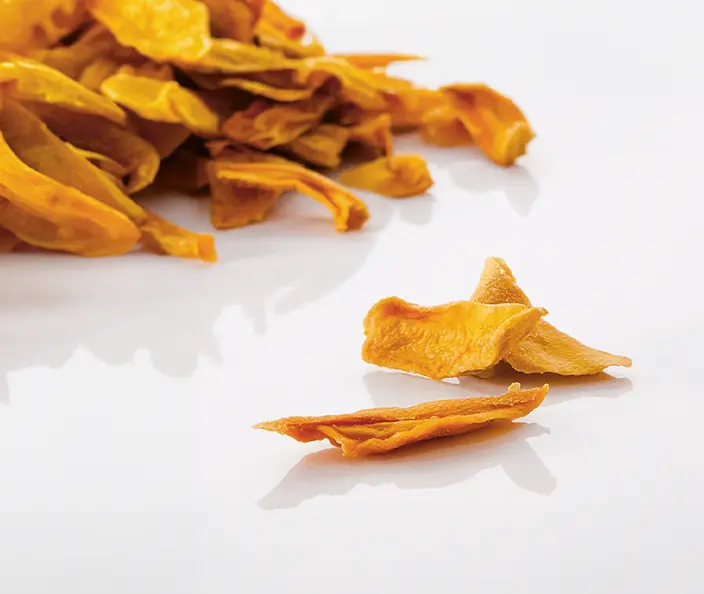
Our dried mangos come from Burkina Faso. From the tree to the packet, the fruit travels an impressive journey.
Harvesting
Mango trees grow almost everywhere in Burkina Faso, as the climate is ideal for the fruit. The family farmers prune the trees so that, at harvest time, they can reach even the topmost fruit using a ‘Kescher’ – a long pole with a collecting device. They also plough the soil so that it can absorb nutrients and to prevent the grass from growing too high – as this would increase the risk of fire during the dry season.
In summer, the family farmers return to the field time and again to harvest the fruit that is almost ripe. It must not yet be perfectly ripe, otherwise it would turn to mush after being transported to the drying facility.
The harvested mangos are stacked at the edge of the plot, where they are collected by a gatherer – usually on a three-wheeled motorbike with a loading area – and taken to the village, where they are transported further by a small lorry.
In the video, you can see how the mango harvest takes place on site:
Drying
Around a quarter of the dried mangos are processed at our factory near Bobo-Dioulasso. The rest come from external processing plants. Once they arrive, staff sort the fresh mangos and weigh them to determine the price. To allow the fruit to ripen further, it is placed in a large basin and covered for a few days. Finally, the staff sort the fruit again and then wash it several times with water to remove dust and soil.
The fruit is then prepared for drying by various teams: some peel the fruit, others cut it into pieces, whilst others lay it out on drying racks. The pieces are then placed in the oven, where they are dried for around 14 to 18 hours. We generate the energy for this from cashew shells, which we use to fire the boiler on the factory premises.
Working in our factory provides many people in the region with a stable income, an employment contract, and social and health insurance.
Sorting and packaging
Once the mangos are fully dried, they are removed from the oven, allowed to cool and taken off the drying racks. Employees then inspect the mangos, sorting out any that are too dark or too dry and cutting any that are too large into smaller pieces. After categorising them into first and second grade, the workers pack the mango slices into plastic bags.
All mangos – including those dried by external contractors – are thoroughly checked once again in our factory. Do the size, variety, colour and moisture content match the order and specifications? And are the correct documents included? These are important, as they guarantee complete traceability.
Next comes a metal detector test, after which the oxygen is removed from the bags and they are filled with a mixture of CO₂ and nitrogen. The resealed bags are labelled and are ready for export.
Transport to Europe
Whilst still at gebana Burkina Faso, the mangos are loaded into a refrigerated shipping container – it can hold around 20 tonnes of dried mangos. Once sealed, it is not opened again until it reaches the Netherlands. Provided the railway line is not closed, the container is transported by rail to the port of Abidjan in the Ivory Coast and loaded directly onto a ship there. After two to three weeks at sea, the container arrives in Rotterdam or Antwerp and is taken to the gebana warehouse in the Netherlands. Some of it ends up in our fulfilment centres for the online shop in Embrach and Singen, and ultimately in your cupboard.