
 Login
Login

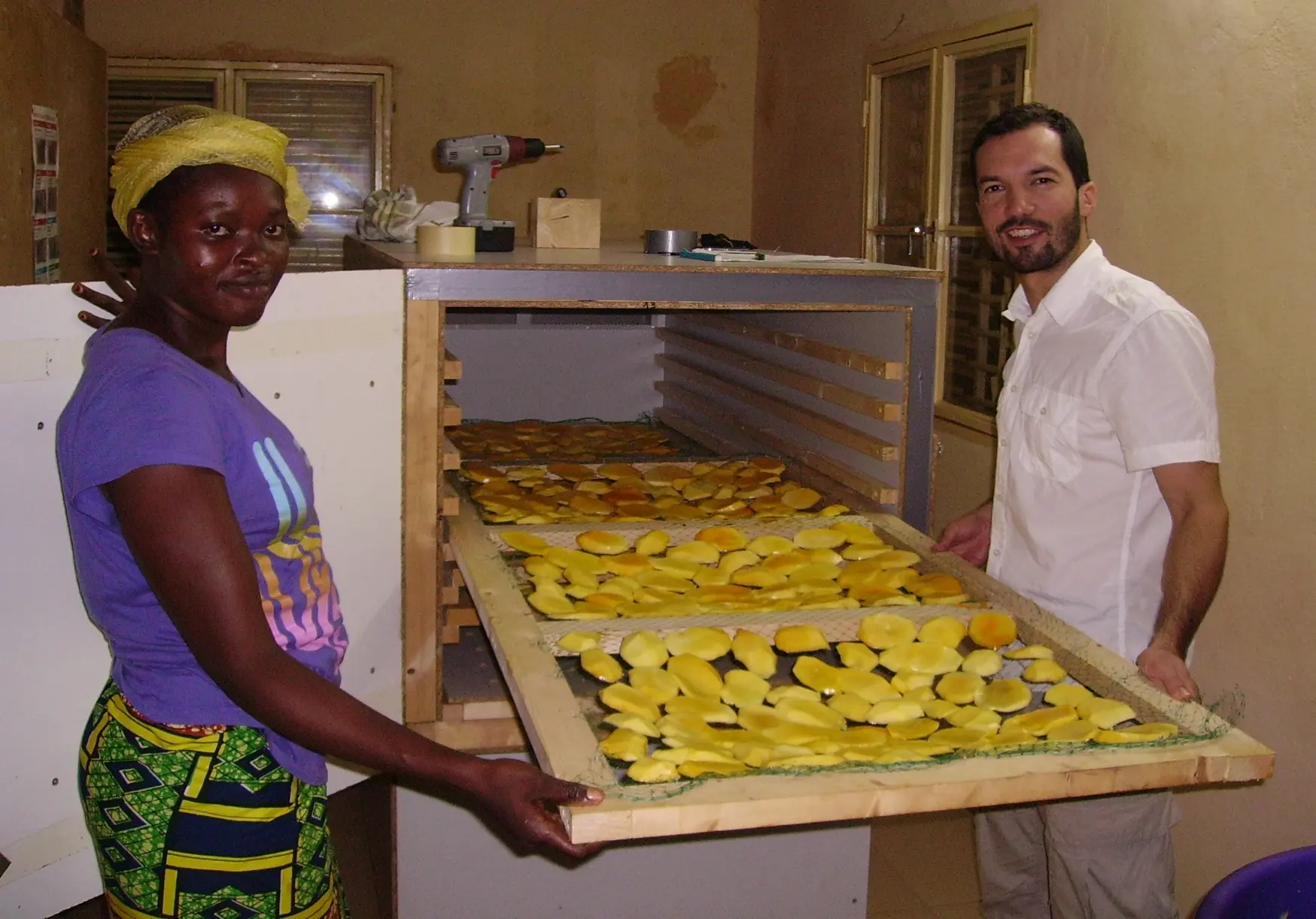
This gave Akos Lukacs the idea not only to change the energy sources but also to rethink the drying technology. The energy-saving heat pumps had proven themselves in Switzerland; why shouldn’t they also perform well in Africa?
Gebana was interested in collaborating on this pilot project not only because of the energy savings, but above all because the new technology was expected to produce better quality dried fruits: because of the less hot drying the fruit pieces are dried more gently and therefore have more flavour, a nicer colour and are softer to the bite.
However, before Akos Lukacs began planning a heat pump dryer, he travelled to Burkina Faso to assess the local level of knowledge. “Our goal was to develop a model system that can be rebuilt locally and thus spread,” explains Akos Lukacs about the knowledge and technology transfer, which is an important project objective. After all, the Swiss technology had to be adapted to the extreme environment of the equatorial region with high temperatures and humidity.
After a longer phase of tests and troubleshooting, the first mangoes could now be dried in the new oven this early summer. Because only one oven is currently available, the quantities of premium mango produced are initially limited. A second heat pump oven is, however, already in planning and should be installed this autumn. When Akos Lukacs travels to Burkina Faso for this installation, he will already be accompanied by a Swiss refrigeration technology specialist who will train the local technicians for the first time.
In the next project step, the energy supply is to become more sustainable. Already by switching to electricity the CO2 emissions could be reduced by half compared with conventional ovens. By means of renewable energies, the supply should become independent in the long term from Burkina Faso’s expensive and unreliable power grid. For this purpose, on the one hand the use of photovoltaics is planned; on the other hand two projects are underway in cooperation with other partners: one is working on producing biogas from mango waste, the other on the use of cashew shells and the utilization of the waste heat generated in the process.
Also in the energy supply the idea of the model system is paramount. Only technologies that are locally available and affordable and that can be handled by local technicians should be used. Because the same applies here: imitation is welcome! For this reason Akos Lukacs checks on each of his trips to Burkina Faso whether the local interest in the Swiss technology still exists, because he is convinced: “Without interest the best idea will not get anywhere.”
Akos Lukacs is a mechanical engineer and has been responsible for development cooperation projects at the Ökozentrum Langenbruck for six years. The heat pump dryer and sustainable energy supply project with gebana Afrique started in 2010
How it works
Unlike conventional gas-fired ovens, the heat pump dryer has a closed air circuit. The air in the dryer is first warmed and thereby absorbs the moisture from the fresh mango slices. The air is then cooled on a cold surface, the previously absorbed moisture condenses and is drained away. Afterwards the same air is warmed again and the cycle begins anew.
The heat pump uses ambient heat for warming and therefore operates particularly resource-efficiently: compared to an electric oven with the same heating effect it saves 80% energy. Another advantage: the air is heated less intensely and thus dries the fruits more gently.