
 Login
Login

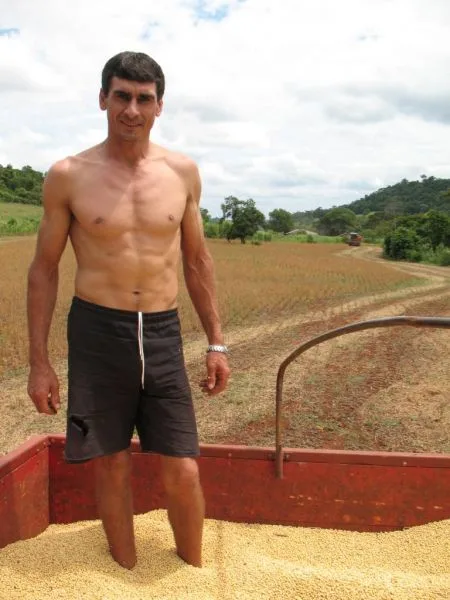
It is soybean harvest time in Capanema, in southeastern Brazil, also for organic farmer Roberto Rama. Neighbor Ernesto has provided his combine harvester and driving services for a fee, friend Mindo his truck for transport.
Roberto Rama can be satisfied; the dry season has hardly harmed his plants, the pale yellow beans are of good quality. Since November he has planted, sown and hoed according to organic Demeter guidelines. This means significantly more work, but at the end of the harvest it is rewarded with prices up to 60% higher than the local market. Yet Roberto Rama remains cautious, because he knows that using the combine harvester carries risks. In recent weeks other farmers have also used it, among them some who cultivate genetically modified soy. Thus equipment and truck loading surfaces can become contaminated and even after thorough cleaning still show traces of genetically altered plants.
A few hours later Roberto Rama's concern is proven true: a rapid test at gebana Brasil's receiving station shows that his soy contains tiny traces of genetically modified organisms (GMOs). His soy is treated separately and can no longer be exported. He still receives the organic premium from gebana Brasil, because the farmers are not to blame. But the result of the rapid test is nevertheless frustrating for him: "I have deliberately been farming organically for many years, you do everything conscientiously and yet it is of no use. Genetically modified soy is a serious problem for us," Roberto Rama notes disillusioned. It is not only contamination that is a problem; fine pollen from neighboring GMO fields can also contaminate the organically grown fields. Everyone involved knows this, but only the affected organic farmers are really concerned.
Just a few kilometers away Abelino Murinelli is also harvesting his field. He smiles as he shows us his work tool, a sickle, and explains that he will cut his entire soybean crop by hand. Family and neighbors help him. People laugh, are amused by our visit and accept the longer and harder work. "It doesn't bother me that it takes longer. More work is part of the daily routine for us organic farmers anyway. But that way I know that not a single bean is lost and that my soy stays clean," Abelino Murinelli explains to us.
The cultivation of genetically modified organisms poses a major problem for the organic farmers in Capanema and therefore also for gebana Brasil, a problem whose solution cannot lie in days of manual labor. A law forbids any genetically modified planting within a 10km radius of every Brazilian national park, including the Iguaçu National Park, to which Capanema directly borders. The passing of the law in 2007, however, changed nothing; genetically modified soy remains a common sight in the Capanema region. Since February of this year the enforcement of the law has been renegotiated, which gives cause for hope: strict enforcement would be a great relief both for the organic farmers and for gebana Brasil.