
 Login
Login

Wenn man 1 Kilo frische Ananas von Lomé in Togo nach Zürich mit dem Flugzeug transportiert, stösst man zwischen 3 und 10,5 Kilo CO2 aus. Einen genaueren Wert zu erhalten, ist schwierig. Die Fülle an CO2-Rechnern, die es inzwischen gibt, führt auch zu einer Fülle an unterschiedlichen Ergebnissen.
Welche Zahl nimmt man also, wenn man das durch Flugfracht verursachte CO2 fünffach kompensieren will? Das ist es nämlich, was wir uns zum Ziel gesetzt hatten, als wir im März 2016 zum ersten Mal frische Sugar-Loaf-Ananas mit dem Flugzeug nach Europa brachten.
Beim ersten Flug in die Schweiz rechneten wir mit Werten von Passagierflugzeugen und kamen so auf 5 Kilo CO2 pro Kilo Ananas oder 35 Kilo CO2 pro Kiste. Bei den folgenden Flügen gingen wir dann vom Ausstoss eines Frachtflugzeugs aus und kamen auf 27 Kilo CO2 pro Kiste für den Transport in die Schweiz. Der Wert ist tiefer, weil ein Frachtflugzeug mehr Fracht befördert als ein Passagierflugzeug und so auf das einzelne Kilo Fracht gerechnet weniger CO2 ausstösst.
When shipping 1 kilo of fresh pineapples from Lomé in Togo to Zurich by plane, between 3 and 10.5 kilos of CO2 are emitted. It is difficult to calculate a more precise amount. The many carbon emissions calculators out there nowadays seem to generate all kinds of different results.
So which figure does one use to offset the carbon emissions from air freight fivefold? Our goal when we flew Sugarloaf pineapples to Europe for the first time in March 2016 was just that, to offset the carbon emissions fivefold.
For the first flight to Switzerland, we based our calculation on passenger plane emissions, which came to 5 kilos of CO2 per kilo of pineapples or 35 kilos of CO2 per crate. The calculation for the following flights was then based on the emissions from a cargo aircraft, and this came to 27 kilos of CO2 per crate for shipping to Switzerland. The figure is lower because a cargo aircraft carries more freight than a passenger plane and therefore emits less CO2 per kilo of freight.
How do you offset carbon emissions fivefold?
Initially we didn't know exactly how to offset carbon emissions fivefold, so we first converted the quantities generated into offset costs. We calculated an amount of around 70 Rappen per crate of pineapples. But we went with the higher carbon emission calculation for the first shipment (1.28 Swiss francs per crate).
Since then, we have been multiplying the offset costs per crate by the number of crates in each shipment, then multiplying this amount by five and paying it into our carbon offset account. Since the first shipment in March 2016, we have flown 25,311 crates of pineapples, emitting around 704 tonnes of CO2, which is equal to a simple offset cost of 18,518 Swiss francs. Multiply that by five and you get 92,590 Swiss francs.
We use this money to finance various carbon offset projects. Two have already been completed and we are implementing the third this year.
Project 1: Cocoa trees in Togo
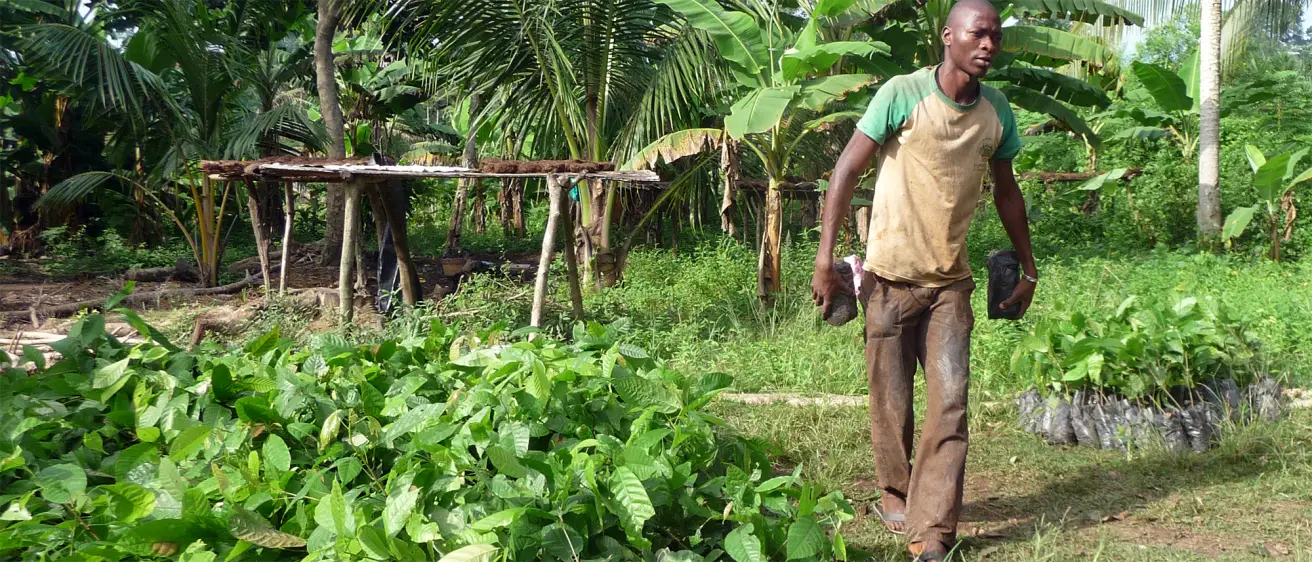
For our first carbon offset project in 2016, we planted 5,000 cocoa trees in Togo, offsetting 1,250 tonnes of carbon emissions. The project cost around 1,192 Swiss francs.
The idea behind it was to capture carbon and create income opportunities for farming families at the same time. However, we now know that the planting campaign was a false success. This is because cocoa trees are generally cut down again after around 25 years, when their yields decline. In the worst case scenario, the carbon stored in the trees is then released again. However, we are not changing our calculation for the moment.
Project 2: A pyrolysis furnace in Burkina Faso
Between October 2018 and June 2019, we developed a pyrolysis furnace together with gebana Burkina Faso that generates energy from the shells of raw cashew nuts. We use this energy to dry mangoes. The energy source normally used for drying ovens in Burkina Faso is gas.
After a few false starts, the furnace is now up and running. We expect to offset 1,971 tonnes of CO2 over its entire estimated lifetime. The project cost around 20,000 Swiss francs.
Project 3: Reforestation in Brazil
Between January and August 2021, 3.5 hectares of land in Brazil will be reforested. To be precise, we are planting 3,668 trees[1]. They are all indigenous species and are not destined to end up as timber. In other words, the trees will not be felled again after a certain period of time.
Two species, Eucalipto and Bracatinga, are represented in greater number than the other varieties because they grow very quickly. Landowners will therefore be able to cut these trees regularly and leave the cuttings to rot. This provides the soil with nutrients, which in turn promotes the growth of the other trees. We expect to offset a total of 611 tonnes of carbon emissions over the next 20 years with the reforestation project. The costs amount to 12,115 Swiss francs.
Positive carbon footprint and still some money in the bank
If we consider all three projects together, we arrive at a carbon offset of 3,832 tonnes. Knowing full well that the project in Brazil has a time horizon of 20 years, our calculations now put us at a net credit of just under 312 tonnes of CO2. At the same time, our carbon offset account also shows a positive balance.
As a reminder: Since the first shipment, we have paid 92,590 Swiss francs into the carbon offset account to date. If we deduct the costs of the three projects, 59,284 Swiss francs are left over.
We can see from this remaining balance and the three projects how complex the issue is and how difficult it is to implement a good offset project. Our conclusion is that we need to implement many more projects.
The key here is to make a difference in areas where the people we work with are living. It is not an option for us to simply buy CO2 reduction certificates. Instead, we seek specific expertise and also offer our local employees and partners the opportunity to submit their own ideas. This is how the project in Brazil came into being.