
 Login
Login

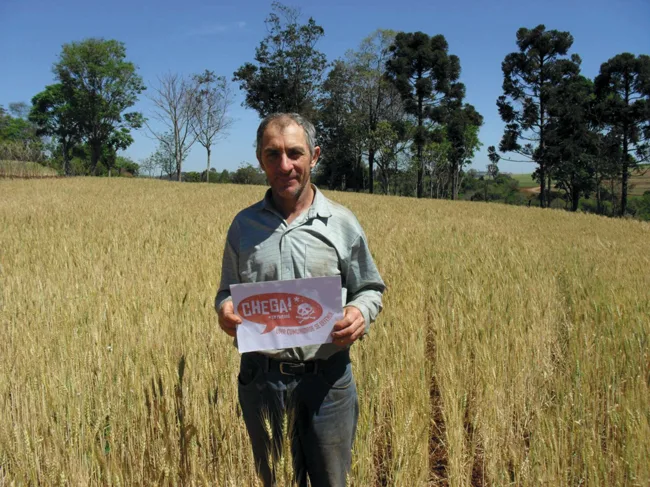
gebana: What, in your view, was the most important success of the CHEGA! campaign?
Marcio Alberto Challiol: The campaign played a very important role in the ban of endosulfan in Brazil. Based on hundreds of pesticide analyses and the investigation of the causes of endosulfan contamination by experts as well as through the CHEGA! awareness campaign, we were able to credibly demonstrate the danger of endosulfan. This decisively influenced the re-evaluation process for the approval of endosulfan that the Brazilian health authority ANVISA was conducting at the time: endosulfan no longer received approval and was banned from 2013 onward.
gebana: What did the campaign mean for gebana Brasil and its organic farmers?
Marcio: The ban of endosulfan is fundamental for organic farming in Brazil and Paraguay; without it, its continuation would have been uncertain. For us at gebana Brasil and for the farmers it was extremely important to show that we were victims and not perpetrators regarding the endosulfan contamination. It was about the credibility of our years of work. In addition, the solidarity experienced through CHEGA! from around the world gave all of us strong support during this time of great uncertainty.
gebana: How many farmers gave up organic production because of the problems in 2010?
Marcio: We lost around 20 farmers. There were not more because gebana paid for the organic soy even before the investigations were completed and the issues regarding export and sale were resolved. Had we paid later, many farming families would have gotten into serious financial trouble. In doing so, gebana took on a great risk.
gebana: How many small farms currently work with gebana Brasil?
Marcio: In the Capanema area we currently work with 84 farming families. The number of small farmers decreased not only because of the problems with endosulfan; for some that was just the straw that broke the camel’s back. There is a fundamental problem that is at the same time actually good news: many small farmers find better livelihoods with jobs in regional centers. Brazil has developed significantly in the last 10 to 20 years. The negative side of this is that these farmers want to manage their fields with less effort and switch to GM crops.
gebana: Will gebana Brasil soon run out of farmers?
Marcio: We are working in two directions to counter this trend. On the one hand we must compensate for the reduction in cultivated area among small farmers to keep processing and trade profitable. Currently we are therefore working with two medium producers of about 70 ha each and two large organic producers who together farm 1100 ha – which is still rather small for Brazilian standards – together.
On the other hand we are investing in the future of organic and small-scale production: together with partner companies and research institutes we are feverishly looking for new ways to control weeds, insects and diseases more efficiently, that is, among other things with less manual labor. In addition, crop rotations and soil fertility as well as soybean and grain varieties must be improved. Furthermore the first small farms in Capanema were able to be Fair Trade certified. With all these measures we were able to break the trend away from organic farming: currently seven new small-farming families are interested in switching to organic farming. We believe that we have thus initiated a turnaround, and we are proud of that. But there is still much to do.
gebana: That is interesting, tell us more about the Fair Trade certified farmers. How many benefit and how?
Marcio: We currently have 25 Fair Trade certified farmers who have joined together under the Association of Sustainable Family Farmers (Associação de agricultores familiares sustentáveis AAFS). The certification is enormously important for them and for small-scale organic farming because it guarantees additional income for the farming families. In addition, more young people and women are being involved in the activities of the AAFS – which is also very important for the continuation of smallholder organic farming here in Capanema.
All information about the Endosulfan scandal of 2010 can be found on the campaign website.