
 Login
Login

Bridge-builder and market opener
Text and image by Wolf Südb eck-Baur
Niangoloko. The Zurich company Gebana AG paves the way for organic and fairly traded mangoes from West Africa to Swiss consumers.
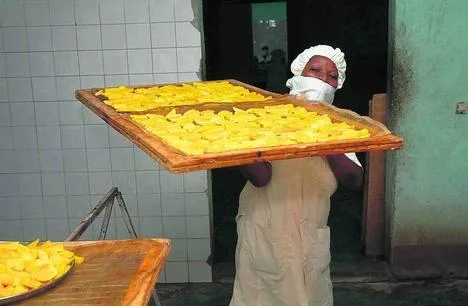
Warehouse manager Mahamadi Traoré proudly points into TON producers' mango warehouse, where some crates of fresh mangos wait to be sorted and processed in the drying facility. His colleague Fati Ouedraogo is in the corrugated-iron roofed storage room busy turning each fruit by hand and checking its texture; overripe and therefore too soft mangos for drying she sorts out. The association founded in 1991 of what are now 33 mango producers in Niangoloko, Burkina Faso, has already accomplished a hard piece of work, says TON coordinator Issaka Sommandé. The smallholders were already packing 25 tonnes of dried mangos for export to Europe into plastic bags in 2007. In 2000, when cooperation with the Zurich fair trade company Gebana AG began, it was two tonnes.
Thanks to bonus for school
According to Issaka, dried mango production provides the 430 TON employees — mostly women — with an income that at the equivalent of Fr. 2.50 per day is 20% above the annual average income of Fr. 500 in Burkina Faso. In the shade of the trees on the TON premises, the numerous motorbikes testify to the development potential of the small loans that cooperative members can obtain from a fund of their organization.
The head of the cooperative emphasizes that the income generated, including the Fr. 24,000 bonuses, "allows cooperative members a normal life." These bonuses were paid out to TON in 2007 because of the Max Havelaar label for fair trade, among others, by Coop via Gebana Afrique . The cooperative, of which 154 farming families are members, used the bonus to buy school supplies, for vaccinations of children against tetanus, diphtheria and polio, and for the purchase of a grain mill. Furthermore, the bonus allows forming financial reserves to ensure the maintenance of the machines and the drying facilities.
Huge increase in sales
The prosperity of the TON cooperative is closely linked to the trading partnership of the TON mango farmers with Gebana Afrique. The trading company based in Zurich builds a bridge between the farmers and consumers in Switzerland. David Heubi, managing director of Gebana Afrique, acts as a market opener for the smallholder families. "We buy the dried mangos from our partners – overall we work with six cooperatives in Burkina – and take care of sales in Europe, primarily in Switzerland." The export volume of organic and fairly traded mangos has thus more than tenfolded within five years. This enormous increase could be realized above all thanks to the entry of Swiss major retailers.
Growth thanks to quality seal
In 2008 Gebana AG will find more than twice as many customers for dried mangos in Switzerland via direct shipping—with an expected 5.5 tonnes—than in 2006. An important contribution to realizing this growth—Gebana deliberately pursues a growth strategy—was due to fair trade and the certification of the mangos with the Max Havelaar quality seal, says Heubi. "Without this label we would not have gained access to the Swiss and European market to this extent."
Gebana and Chairman of the Board Adrian Widmer are all the more pleased because the success story of the mangos proves that the market is obviously able to pay for economic, ecological and social values; values, moreover, that smallholder families and local processors like the TON cooperative in Burkina Faso create.
http://www.tagblatt.ch/aktuell/wirtschaft/tb-wi/art149,717021