
 Login
Login

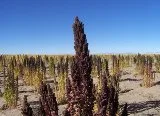
The main beneficiaries are the producing families, but also the country's processing industry. Thanks to this quinoa boom, rural exodus in the highlands of Bolivia now appears to be increasingly reversing. People are returning to the countryside.
Bolivia is a world leader in quinoa cultivation with an annual production of around 23,200 t of quinoa (as of 2008). More than 50% of this goes to official exports, 40% is smuggled to Peru via the black market (!) and about 10% is consumed in Bolivia on the domestic market. The following aspects must be viewed in a differentiated way:
- The government deliberately gives priority to developing the domestic market.
- Exports have led to increased organic quinoa cultivation. This organic production yields sustainable and economic benefits from otherwise infertile soil.
- The quinoa on the Bolivian menu is different from the export quinoa and therefore is not directly in competition with the export product (Quinua Real). It is mostly of a different variety (Quinua Dulce) and comes from a different growing area (northern Altiplano, where Quinua Real does not grow).
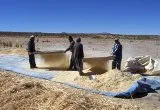
In the inhospitable region of the Altiplano (Bolivian highlands) - at over 4′000 m above sea level - quinoa plays an important role as a livelihood for about 70′000 producer families. Fortunately, the quinoa boom has mainly benefited rural producers. Due to production quantities and the fact that in the quinoa cultivation areas (nutrient-poor soils, drought, heat and cold fluctuations) practically no other plants survive, the export of quinoa must be further promoted. The rediscovery of this Andean plant and its marketing contribute to overcoming poverty.
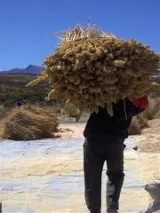
Bolivia safeguards over 3,200 varieties of quinoa. Only a few of these are used commercially. The quinoa grain, in its many processed forms, provides great variety in our kitchens. There is still much potential for the consumption of quinoa grains and by-products such as puffs, muesli, pasta, flakes, soups, etc. This potential must be seized by processors in Bolivia, because today the majority of quinoa exports (95%) reach industrialized countries as raw grain. Bolivia could generate much higher added value by selling “finished” quinoa products. A quinoa farmer clearly said during our last visit to the field: “Eat more quinoa over there (in Europe), it helps us!”
Read the current blog from swipala directly from Bolivia.